An Introduction to the Concept of the
Septenary Nature of Humankind
Janet Hoult, Trustee, The Blavatsky Trust.

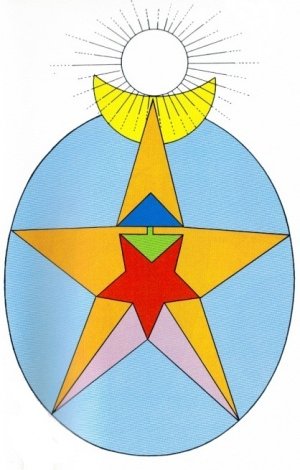
This article is from a talk given at the European School of Theosophy London Conference 2024. It is a summary of the seven principles, universal to all aspects of Theosophy and with particular reference to how they occur in Humankind.
_____________________________________________
The core teaching that humankind has seven principles is essential to an understanding of Theosophy. Referred to throughout H.P. Blavatsky’s writings, they are outlined in her 1889 book The Key to Theosophy, and further explored in the Esoteric Instructions. They are also mentioned throughout The Secret Doctrine.
The concept first appeared in Esoteric Buddhism (in book form) by A.P. Sinnett in 1883. The majority of the Mahatma Letters were written to him so he was well acquainted with Theosophical teachings early on.
These seven principles consist of a lower quaternary including the physical and astral bodies, and an upper triad of mind, soul and spirit. They illustrate the progression and evolution of humanity in line with the third fundamental proposition in The Secret Doctrine Proem, page 17 – that of the need for the “obligatory pilgrimage of every Soul [to go] through the Cycle of Incarnation”, and this is so important to our understanding of what happens to us when we so-called ‘die’.
These principles have been referred to throughout the conference so far, and will, no doubt, be addressed in Tim’s film [The Myth of Death: link, and therefore I would think we all have a pretty good idea about the subject.
So I just want to have a look at some of the more interesting points connected with this...
... in fact the whole universe is built on sevens - including our planet, which has 7 planes or layers of being (Key 88); there are also;
• 7 evolutionary worlds,
• 7 creative forces of nature (SDi 635);
• 7 top Dhyani Buddhas or ‘Seven Sons of Light’ (SDi 572);
• 7 groups of Dhyan Chohans – the angelic forces which make up the primeval Seven Rays (SDi 571)
H.P. Blavatsky gives details of the septenary principles in The Key to Theosophy:
– the upper or spiritual being, composed of three ‘principles’ or aspects; and – the lower or the physical quaternary, composed of four – in all seven.” (Key 90-91)
It looks complicated, but if we think about it we are different people at different times:
• When we meditate or listen to a beautiful piece of music, we are transported, upwards, and our spirits are lifted.
• When we’re working or being intellectual our minds can be quite mechanical.
• If we get upset, or angry, we are in a different place again, which feels darker and lower in vibration.
The Septenary Division also appears in Buddhist and Indian teachings, there’s a table on page 157, volume 1 of The Secret Doctrine showing Esoteric Buddhist, Vedantic and Taraka Raja Yoga classifications.
Interestingly in The Key to Theosophy they’re shown in two parts –
– Lower quaternary bottom of page 91,
– then you have to turn the page, and the upper triad on page 92 is placed at the top, which emphasises the division between the two.
There is quite a strong psychological effect ... going from the bottom of one page then leaping up to the higher triad on the next page.
Looking at the lower quaternary, this has a base in the physical and dies when we ‘die’ – as has been referred to several times over the last couple of days.
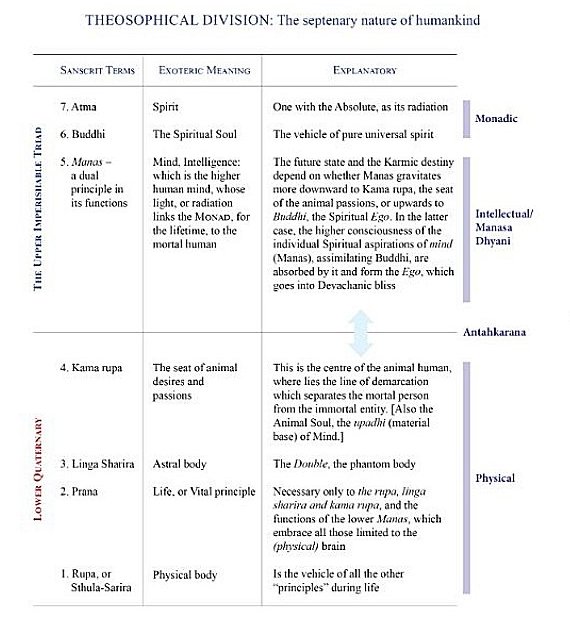
I have combined these two diagrams (as above) so that the whole picture becomes clearer
1. The Physical, Sthula-Sarira
“The Sthûla-Sarîra is made up of molecules, informed and ensouled by Atoms. The molecule has in it the Seven Principles, in their Prâkritic – ie material – manifestation.
It is a fascinating view “As man, as a whole,” says HPB, “contains every element that is found in the universe, and as there is nothing in the Macrocosm that is not in the Microcosm; so every molecule is, in its turn, the mirror of its universe, Man.”
NB. not just males – this refers to humanity as a whole.
It is this which renders man alone capable of conceiving the universe on this plane of existence – we have in each of us the Macrocosm and the Microcosm.
Esoteric Section, Instruction V, Collected Writings XII page 703)
....and a reminder that even this dense, physical body is a mass of vibrating molecules.
2. Prana, Life or Vital principle
“ ‘Prana’, or ‘Life’, is, strictly speaking, the radiating force or energy of Atma – as the Universal Life and the One Self” (Key 176)
“Prana ... permeates the whole being of the objective Universe; and is called a ‘principle’ only because it is an indispensable factor” and the driving force, the energy of the living person.”
In connection with the human body “The circulation of Life, Prâna, through the Body is by way of the Blood. It is the vital Principle in us, Prânic rather than Prâna, and is closely allied to the 3rd level, the Astral (Linga-Sarîra) and the 4th level, the Desire Body (Kâma).
3. Astral Body Linga Sarîra
“The Linga-Sarîra, or ethereal double of the Body, is molecular in constitution, but of molecules invisible to the physical eyes....”
It “is the vehicle of Prâna, and supports life in the Body. It is the reservoir or sponge of life, gathering it up from all the natural kingdoms around, and it is the intermediary between the kingdoms of Prânic and physical life. Life cannot pass immediately and directly from the subjective to the objective, for nature passes gradually from sphere to sphere, overleaping none.” (CW12 704).
The Linga-Sarîra literally means the Model-body: linga – model, sarira – form, derived from the root-verb sri – to waste away; hence linga-sarira implies a model that is impermanent.
“This Model-body is more ethereal than the physical body. It is the causal form from which flow the energies which build the physical body atom for atom. Like the Astral Light it automatically records all the effects of the earth-experiences lived through by the person” says Judith Tyberg in her dictionary Sanscrit Keys to the Wisdom Religion (1940).
There is a type of photography which takes pictures of the human aura, where one is able to see forms which are present in the aura and which can manifest in the body a few months later. The lady who took my photo (about 20 years ago!) insisted it was not the kirlian system. Looking on the internet there appear to be places in both London and Glastonbury which offer this service.
This then is the lower astral form.
There is a higher astral form – the Mayavi-rupa – (rupa means body or form)
This is the ‘illusory body’ or ‘thought-body’ of an Initiate; the ‘higher astral mental form’. This form is created by the power of will and thought of an adept, and it may be made an exact double of the person or any other shape desired. It is called an illusory body because it is only a temporary creation of the adept. When it has accomplished the intended purpose of the adept it is withdrawn and dissolved.’
Hence stories throughout the early Theosophical writings of various appearances by the Masters and others when they were known to be elsewhere. Mrs Cooper Oakley recounted seeing Master M suddenly appear at Adyar in the January of 1885 when HPB was very ill. She wrote: “Suddenly there appeared on the verandah the Master M, fully materialised; he passed quickly through the outer room into HPB’s room.” He discussed with HPB, the other occupants later found out, the option that she could die peacefully, or that she could live, and write The Secret Doctrine.
4. Kama rupa, Desire Body
Kama is the seat of the driving and electrical forces in man, the basis of action.
This can be confusing! It’s not karma, but kama... hence The Kama Sutra, the manual on love-making.
The kama rupa or form has animal cunning or intelligence. For instance, when you look at a cat you can sometimes see it is figuring something out. It is intelligent, but we humans have something more, some spark, self consciousness, which is still dormant in the animal.
It is the centre of the animal human, also called the Animal Soul, and marks the line of demarcation which separates the mortal human from the immortal entity.
The link between the lower quaternary and the upper triad is known as the Antahkarana, sometimes called the rainbow bridge.
The Upper Triad consists of:
7. Atma Spirit One with the Absolute, as its radiation.
6. Buddhi The Spiritual Soul The vehicle of pure universal spirit.
Then this strange intriguing thing called Manas, which occupies no. 5. and, we are told, is a “dual principle in its functions”.
At the time of the beginning of the Third great root race humankind needed to become more physical in order to evolve. We are not talking here about race as it is generally known today, it means people of every colour, humanity as a whole. At this stage we were not as physically dense as we are now, and sexual reproduction had not yet evolved, we were hermaphrodite, there was no ‘gender’.
It is made up of the lower 4 principles, and the top two – Atma and its vehicle Buddhi referred to as the Monad – where does it come from?
The Monad – Atma and Buddhi
You’ve got one, I’ve got one... but they’re not ours at all, they don’t belong to us – they’re part of the Absolute.
They emanate from the Absolute, and are sparks of the Divine, (‘an indestructible star of divine light and fire’) thrown out to experience the circle (or cycle?) of necessity, while at the same time still being one with the Absolute. You may have heard it described many times as the divine spark within the fire... or the drop within the ocean.
In The Secret Doctrine, volume II, Anthropogenesis on page 105, is a stanza describing how the pitris/angelic beings created the lower quaternary, a physical form to house the Breath, the human Monad. But that “Breath needs a mind to embrace the Universe” – there is nothing to link the two.... “Thus Man remained an empty, senseless Bhuta” (Bhuta, sanskrit for a ghost or phantom). They are described as “aëriform, devoid of compactness, and MINDLESS”.
There’s no self-consciousness – nothing to link that highest spiritual part with the lower physical brain and body.
What is it that links it?
The answer is MIND, and this is provided by the Manasaputras, the ‘Sons of Mahat’.
Mahat or the ‘Universal Mind’ is the source of Manas, the 5th principle, ie. mind, in mankind. Manas is also called ‘Embodied Spirit’, because it is, according to our philosophy, says HPB, the Manasa-putras, or ‘Sons of the Universal Mind’, who created, or rather produced, the thinking man. (Key 135)
What are they?
They are spiritual beings who have to continue their development. They are more like ‘forces’, they are “Essences”, “Intelligences”, and conscious spirits; entities seeking to become still more conscious by uniting with more developed matter.
Their essence is too pure to be distinct from the universal essence; but they have to pass through earthly human experiences to become all-wise, and be able to start on the returning ascending cycle. (SDii 167)
They are not all one group. The Manasaputras are all different. There are many levels and grades depending on their level of evolution. For example, kumaras and agnishwattas are very high grades, and there are many lesser grades – there are as many different types as there are each of us.
Where did they come from?
HPB, (SDii 80), writes that according to the “the semi-esoteric allegories, these Beings were returning Nirvanees, from preceding Maha-Manvantaras — ages of incalculable duration which have rolled away in the Eternity....”
Some Vedantins might say: ‘This is not so; the Nirvanee can never return’; which is true during the Manvantara they belong to, and erroneous where Eternity is concerned.
For it is said in the Sacred Slokas:
“The thread of radiance which is imperishable and dissolves only in Nirvana, re-emerges from it in its integrity on the day when the Great Law calls all things back into action. . .”
This ties in with what HPB says in the notes to The Voice of the Silence – they’re what the Mahayana Buddhists call Pratyeka Buddhas.
“Note: Pratyeka Buddhas are those Bodhisattvas who strive after and often reach the Dharmakaya robe after a series of lives. Caring nothing for the woes of mankind or to help it, but only for their own bliss, they enter Nirvana and – disappear from the sight and the hearts of men. In Northern Buddhism a ‘Pratyeka Buddha’ is a synonym of spiritual Selfishness.” (VoS 86)
So, even the Pratyeka Buddhas, so criticised in The Voice of the Silence for being selfish, have to come back, in the next Maha-Manvantara, to carry on their evolution by providing the link-energy for the next wave of humanity.
It’s an amazing concept, this huge rolling tide of evolution. But humanity in the meantime has moved on, it doesn’t stop, and these high spiritual beings, residing in Nirvana have fallen behind. So, when the time is right, in the new Maha-Manvantara, they have to come out to combine with each physical vehicle/atma buddhi in order to continue their evolution.
Each one of us has our own distinct one. They are us.
There’s a description in Collected Writings Vol XII, originally from the Esoteric Section papers, where HPB describes how the Manasaputras blend with the human.
As the teachings say: “Each is a Pillar of Light. Having chosen its vehicle, it expanded, surrounding with an Akasic Aura the human animal, while the Divine (Manasic) Principle, settled within that human form.” (Collected Writing Vol XII 608)
For the remainder of this Manvantara, Manas, along with Atma and Buddhi form our upper triad. It is immortal and imperishable.
With each new rebirth, a new lower quaternary is created.
When did this happen?
The Manasaputras entered us half way through the third root race when humanity had solidified enough to be able to reproduce sexually, that point when mankind became self-conscious, and we will work together until the end of this Manvantara.
It is only at the mid-point of the 3rd Root Race that man was endowed with Manas, MIND.
What sort of time scale are we talking about?
Mankind, having passed through all the kingdoms of nature in the previous three Rounds, his physical frame – one adapted to the thermal conditions of those early periods – was ready to receive the divine Pilgrim at the first dawn of human life, i.e., 18,000,000 years ago. (SD ii 254)
To return to the quote
“The thread of radiance which is imperishable and dissolves only in Nirvana, re-emerges from it in its integrity on the day when the Great Law calls all things back into action. . .”
... and mention of this thread of higher Manas recalls the concept, also found in the ancient works, of the “Karana Sarira on the plane of Sutratma, which is the golden thread on which, like beads, the various personalities of this higher Ego are strung.” (SD ii 79)
It is a beautiful way of describing it, this golden thread. In The Key to Theosophy the Sutratma is called the ‘thread-soul’. (Key 163)
These Secret Doctrine pages, 79 to 81, are a fascinating account of the coming of the Manasic principle, and worth further study. This subject is referred to, many times, throughout The Secret Doctrine and The Key to Theosophy.
Manas, then, comes into the 5th principle. But it also uses the 4th – it comes, or rather we come!! to learn.
So part of us lodges in that 4th vehicle, alongside the animal intelligence and the passions, in order to learn and to pass through human experiences, in order to become all-wise.
This way, we continue our evolution on the ascending part of the cycle.
What we learn, the higher thoughts and consciousness, experiences, spiritual aspirations, “the fruition, the spiritual aroma of the Manas” lift up through the antahkarana bridge, to be assimilated by Higher Manas.
When we die, the upper triad – Manas and the spiritual things we have put into Higher Manas during this lifetime, together with Atma and Buddhi (which are attached but which are ‘impersonal’), enter Devachan for rest and bliss (“with an utter temporary oblivion of all the miseries and sorrows of life” – not Nirvana which lasts the Manvantara, ).
After not less than 1,500 or 2,000 years of Devachanic life, we are called back into incarnation, and we come back and learn some more.
(CW VII 180: Article by HPB from 1886, Theories About Reincarnation and Spirits)
To finish then – it’s a huge rolling evolution that we’re all involved in. We have, as well as we are able, to become co-workers in the cyclic task, and do our best. As HPB says in The Voice of the Silence: be not discouraged, but try, ever keep trying... “For no efforts, not the smallest – whether in right or wrong direction – can vanish from the world of causes... The pepper plant will not give birth to roses, nor the sweet jessamine’s silver star to thorn or thistle turn.” (VoS 34)
Question: What do I think happens when we meditate? What happens regarding Atma, Buddhi, Manas?
I’d like to mention a very interesting booklet called A Mind to Embrace the Universe by
E.L. Gardner. In it he enlarges on two or three things which come up in The Voice of the Silence. (I must mention that E.L.G. studied the Esoteric Section instructions, and appears to have been very sensitive.)
One of these is the passage, on page 16 of The Voice of the Silence:
“Merge into one sense thy senses ... that sense alone which lies concealed within the hollow of thy brain.”
He draws an analogy between the amoeba – a single celled animal which feels solely through its outer membrane, and the human mental body, the aura. By withdrawing other senses during meditation, we can achieve a heightened awareness of the spiritual through the outer periphery. That is one thing.
If it were to be still for a moment, we would be able to see the nucleus of the amoeba. E.L.G. continues the analogy by saying that in the human, our nucleus coincides with the hollow of our brain, and during life “is in the form of a sphere of brilliant clarity ... aglow with the astral light of the higher mental plane”. He then explains how, in ‘the hollow of our brains’ – close to the central (3rd) ventricle, are two glands – the pineal and the pituitary. The ray of the Manasaputra comes in through the pituitary, and the ray of the Dhyani-Buddha into the pineal. The ray of Atma comes in through the crown of our heads, straight into that brilliant sphere. So, secondly, when we meditate, maybe we are attempting to make ourselves aware of these forces.
My apologies to E.L.G. for rushing through his very interesting little book, and obviously it’s a very simplified summary – the original is more complex and the concepts much better explained.
A Mind to Embrace the Universe by E.L. Gardner. Published by The Theosophical Publishing House Ltd., reprinted from The Theosophist, December 1960, reprinted 1965, 14 pages.
Notes on time-scales referred to
Maha-Manvantara as on SDii 602
Mahamanvantara on SDi 359
length - SDii 68-70
“a full period of one Manvantara is 308,448,000 years”
14 Manvantaras plus a Sâtya-Yuga – make one Day of Brahmâ, or a complete Manvantara - 4,320,000,000 years
SDi 36
The time-span of the Seven Eternities or Maha-Kalpa given at the beginning of The Secret Doctrine is 311,040,000,000,000 15 numbers
